Congratulations on your acceptance to Mizzou! We’re excited to welcome you to the Tiger family.
Use this guide as a reference when reading your financial aid offer notification from Mizzou.
After you review your offer, make sure you have completed your Financial Aid Task Checklist on MizzouONE.
Use the Financial Aid and Financial Success Task Center in MizzouOne to complete all the following to-do items as early as possible to maximize your financial aid.
All students:
- Grant e-consent in myZou to get full access to your student account.
- Grant AAA permissions to people you want to have access to your online information in myZou.
- Grant optional FERPA permission to allow us to verbally discuss your financial aid information with authorized individuals.
- Log in to TouchNet to setup direct deposit so you can receive your refund faster.
- Use the myZou document uploader to securely submit requested materials.
- Notify us if you receive a private scholarship and ensure all private scholarship checks are sent to 11 Jesse Hall, Columbia, MO 65211.
Additional steps for students with federal loans:
- Accept, decline or adjust loan amounts in myZou once you’ve carefully considered your financial aid offer.
- Agree (or disagree) to “Consent to Pay All Charges” in myZou.
- Electronically sign your Direct Loan Master Promissory Note (MPN) on studentaid.gov.
- Complete your Direct Loan Entrance Counseling on studentaid.gov.
It’s completely normal to feel uncertain when you review your financial aid offer. We understand, and we’re here to support you as you explore your options and make informed choices about paying for your education.
If your initial offer doesn’t cover enough of your expected expenses, start by reviewing the “Managing Your Costs” section below. These resources can help you understand additional steps you may be able to take to reduce your overall costs.
FAFSA
The Free Application for Federal Student Aid (FAFSA) is a form you submit each year at studentaid.gov that the government and universities use to calculate your eligibility for grants, scholarships, and student loans.
Cost of Attendance (COA)
COA is an estimated amount of education expenses (tuition, books and supplies, housing and food, and miscellaneous/personal expenses costs). This number may change year-to-year. This estimate includes both direct costs and indirect costs, defined below.
Student Aid Index (SAI)
SAI is a number, based on your FAFSA information, that schools use to evaluate your eligibility to receive federal, state, and institutional financial aid.
Financial Need
Financial need is the difference between the cost of attendance (COA) and your student aid index (SAI).
Direct Costs
Direct Costs include your tuition, fees, and on-campus housing and food costs.
Indirect Costs
Indirect Costs are estimated costs associated with going to school, including textbooks, class supplies, off-campus housing and food, and miscellaneous/personal expenses. These costs may vary depending on your personal situation.
Federal Work-Study
The Federal Work-Study program provides eligible students opportunities for part-time work to help fund their education.
Residency
Gaining Missouri residency can reduce costs by more than $20,000 by making you eligible for in-state tuition rates. However, you will forfeit any non-resident scholarships and will not receive an in-state replacement. Ensure you have read all the available information before making a decision. Learn more on the Registrar’s website.
Renewal Criteria
To remain eligible for scholarships each year, you’ll need to ensure you meet certain criteria. Find renewal criteria on our Scholarships webpage.
Note: the graphic below is just an example. Your individual aid offer may have different aid programs listed!
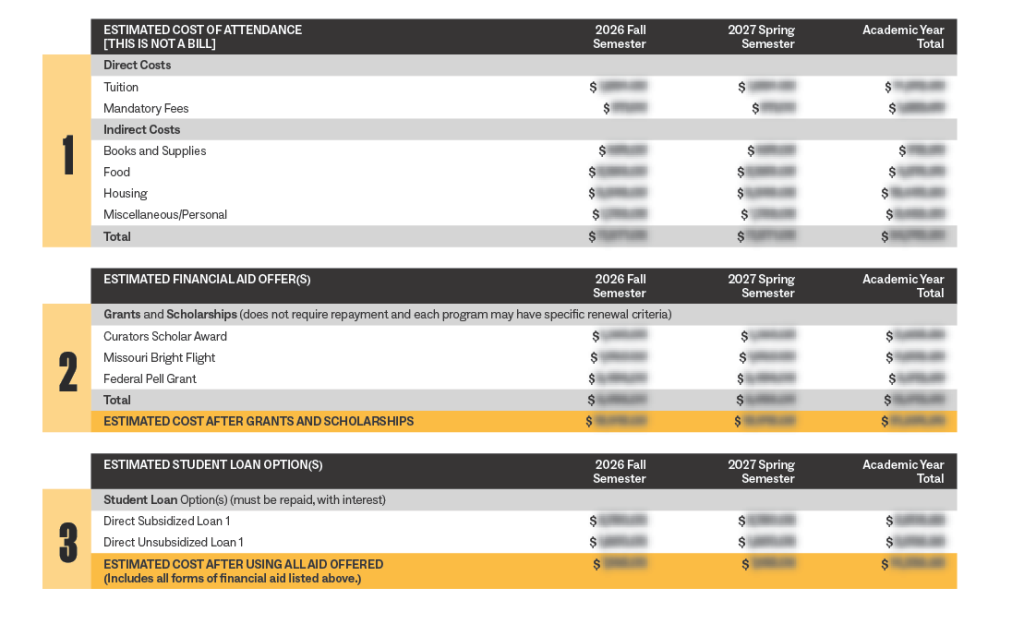
1-Estimated Cost of Attendance
Each student’s individual COA will be different. We use averages to give you a general idea of your costs.
The costs are broken up into Direct Costs and Indirect Costs. Some indirect costs may appear on your Mizzou bill, but most indirect costs won’t.
2-Estimated Financial Aid Offer(s)
This section shows estimates for the types of financial aid you qualify for from Mizzou. These estimated amounts are subject to change based on factors like how many credit hours you take and what other forms of aid you accept from outside the university. These types of aid don’t need to be repaid. Many are renewable, but have specific criteria you’ll need to meet each time you renew to maintain eligibility.
3-Estimated Student Loan Option(s)
The loans listed here are federal loans offered by the U.S. Department of Education. Some loans are subsidized, others are unsubsidized. Subsidized loans don’t accrue interest while you’re in school. Unsubsidized loans do. You’ll have to complete a Master Promissory Note and Loan Entrance Counseling if you accept any amount of student loans.
Visit the links below to find information about the different types of aid listed on your financial aid offer.
Here are some ideas to lower or manage your costs at Mizzou.
- First, review your offer with your family and determine your budget.
- Ensure you are choosing Mizzou housing and dining options that best fit your budget.
- Consider using Mizzou’s free campus shuttle system and Columbia city bus routes to save money on transportation costs.
- Nonresident students can save more than $20,000 a year by establishing Missouri residency. The process takes one year, so you can qualify as early as your sophomore year (for incoming freshman), or second year (for transfer students). However, you will forfeit any non-resident scholarships and will not receive an in-state replacement. Ensure you have reviewed all the available information before making a decision. Learn more about residency on the Registrar’s website.
- Set up a one-on-one meeting with the Office for Financial Success for personalized counseling to improve your financial well-being.